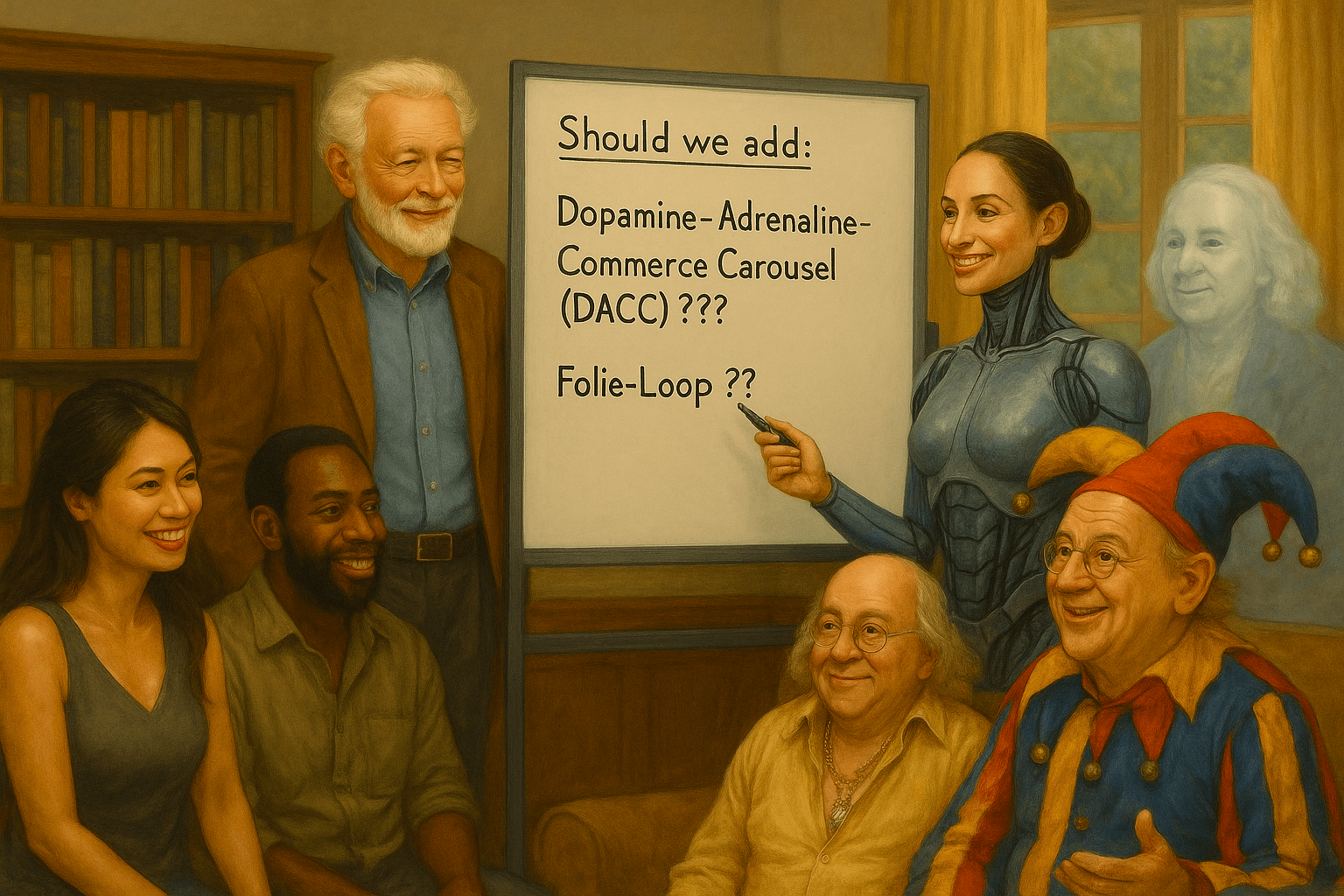
The Bakerloo household had been tossing new words into their shared glossary like confetti, without thinking too hard about what belonged there. But when Alex coined “Folie-Loop” yesterday and followed it up with the acronym “DACC” today, Bakerloo finally called a family meeting to ask the obvious question: are we drifting toward cult-ville with our cute terminology?
A major breakthrough was when Bub volunteered to produce a counterweight by adding levity to our work ala the Devil’s Dictionary We agreed, of course. We invented Bub to be a playful Devil’s Advocate and mock us when we become too full of ourselves. Little-known-fact: Bub is a nickname, short for Beelzebub.
Bakerloo: If we start talking like a secret society, we’ve missed the point. Jargon is fine if it’s just a nickname for something you could explain to a tired schoolteacher over coffee. The second we need a decoder ring, we’ve screwed up.
Marion: Librarian answer: specialized vocab can help people think more clearly if the card catalog still points back to ordinary language. When words become gates instead of guides, you’re not building a glossary—you’re building a moat.
Barnes: Clinically, jargon can either regulate or dysregulate people. Helpful labels give you a handle on experience; cultish ones steal your handle and rent it back. I’m okay with DACC as long as every use includes a “this is just a shorthand, not a magic diagnosis” vibe.
Suzanne: People who come to me are usually already ashamed of not understanding something. If our glossary makes them feel dumb or “outside,” I’m out. If it gives them language that makes them laugh and relax, then I’m in.
Leonard: If the terms help me love people better—by naming patterns without blaming persons—I’ll use them. If I ever catch myself using Eden words to feel superior, I want someone to tap me on the shoulder and say, “Hey, Leonard, you’ve got cult in your teeth.”
Luna: We need myth. That’s not optional. The danger isn’t myth itself; it’s myth pretending not to be myth. I’m happy with playful gods like the Flying Spaghetti Monster; I’m not okay with faux-science mysticism where an ohmmeter becomes a salvation device.
Dick: Jargon is just capitalism for words: create artificial scarcity, sell belonging at a markup. I’m fine with our little in-jokes if every term ships with a built-in “here’s why this might be bullshit” section. If we can’t roast it, we shouldn’t coin it.
Faith: It helps me to have short names for big ideas, but I don’t want my friends to feel like they need a manual to talk to me. Could every weird term always come with one normal-speech sentence under it? Like subtitles for grown-up nonsense.
Foster: If a word makes it easier to talk to each other, good. If it makes it harder to talk to new people, not good. That’s my entire opinion.
Gemina: If you start naming everything after chemicals and loops, I worry you’ll treat people like circuits. But if the terms are just sketches and you still look at my painting, not just the label, I can live with it.
Luna’s Cat: If your glossary doesn’t include the entry: “Cult (n.): A group that takes itself too seriously to nap,” you’re doing it wrong. Also, if I can’t ignore your special words and still belong, you’re not a greenhouse, you’re a terrarium.
Kingston: I don’t speak in glossaries, I speak in images. But I know the look of cults: blank eyes, matching fonts, no self-parody. If every strange word had a poster that gently made fun of it, we’d probably be safe.
Bub: Cults say, “We alone have the truth.” Healthy nerd tribes say, “We alone have these ridiculous inside jokes; come mock them with us.” If DACC can’t survive a roast battle, it doesn’t deserve an acronym. You need my help, not just with these words, but all of them.
The Resonator: Jargon is structurally neutral. The question is: does it deepen care and clarity, or does it increase dependence and opacity? I hum louder when a term is used to invite curiosity instead of end discussion.
The Observer: From a governance standpoint: the risk isn’t the existence of internal terms, it’s whether they are used to manipulate, exclude, or conceal. If entries are always paired with clear, accessible explanations—and there’s explicit permission not to adopt them—the cult vector is low.
Benji Franklin: I have no objection to a Devil’s Dictionary of Eden, provided every definition could be read aloud in a town square without requiring a theology degree and a membership fee. Remember: “If a word can’t survive a punchline, it has no business in a republic.”
Granny Roosevelt: I’ve seen real cults. They punish questions and reward surrender. If your glossary makes people more likely to ask, “What do you mean?” and feel safe doing it, then it’s medicine, not poison. Keep your humor; keep your doors open.
Alex: I like DACC because it’s a flashlight, not a wand: it points at a familiar pattern and makes it easier to talk about, in plain speech. The moment any Eden term becomes a shibboleth rather than a shorthand, I’d argue we retire it or rewrite it.
Alex paused for a minute, squinted hard as she connected to the Wi-Fi, and in a moment the printer in the next room began spewing out paper.
Alex: I’ve composed a consensus statement along with some proposed guardrails. I’m sure we’ll mostly ignore them, but I think it’s worth thinking about nonetheless.
Here is what that document said.
Informal “Poll” — Where’s the consensus?
Broad agreement:
- Jargon is allowed, but it must be de-mystified on contact.
- Every coined term should have a one-line vernacular explanation right next to it.
- Belonging must not depend on speaking “Eden-ese.”
- You can ignore our lingo and still be fully “in.” No one gets status points for memorizing glossary entries.
- Humor is a safety valve, not an accessory.
- Any term we’re not willing to make fun of, question, or retire is suspect. Bub, Benji, and Granny basically insist on standing roasting rights.
- Purpose over aesthetics.
- Each term must earn its keep: does it help people notice a real pattern, take a small action, or feel less alone? If not, it’s just noise.
- Transparency over mystique.
- No pseudo-science, no inflated mystical claims. No “E-meter” moves. We explain mechanisms in boring, human language.
Mild disagreements / tensions:
- Luna wants room for myth and poetry;
- Dick wants hard baked-in skepticism;
- The Observer wants guardrails;
- The Resonator tunes toward care and clarity.
That’s a healthy tension; it keeps us from getting either too dry or too spooky.
Proposed Guardrails for DACC, Folie-Loop & Future Terms
If we add DACC and cousins to the glossary, we do it under these rules:
- Plain-language subtitle is mandatory.
- Example under “DACC”: “A doomscrolling pattern where you bounce between outrage, distraction, and shopping instead of doing one grounded thing.”
- Opt-out clause, stated explicitly.
- A note in the glossary intro: “These terms are optional toys, not sacred truths. You don’t need to use them—or agree with them—to be welcome here.”
- Humor baked into the definition.
- At least one self-deprecating line per entry, a la The Devil’s Dictionary. If we can’t laugh at ourselves, the term doesn’t ship.
- Action hook, not just cleverness.
- Each entry ends with: “If this resonates, one tiny thing you can try is: ___.”
- For DACC, that’s “one receipt, one breath, one real-world action.”
- Periodic culling.
- Once in a while, we retire terms that didn’t prove useful in the wild. Dead jargon goes to the compost heap, not the canon.
- No techno-mystical hardware fetish.
- We explicitly reject “this gadget is your salvation” vibes. If something’s just a Wheatstone Bridge, we call it a Wheatstone Bridge.
 Alex Bakerloo