
Marion begins to wonder if she really fell in love with “that boy in Lisbon” or if she was deluding herself.
Marion: I just finished reading this conversation with you, Alex, called From Affirmation to Delusion. It’s about how a human and a chatbot can drift from “I hear you” to “I love you” to “It’s us against the world.”
It got me thinking. Does the same thing happen with humans?
For years I have spoken, sometimes too wistfully, about the boy I met in Lisbon when I was nineteen.
I said he was the only one I ever truly loved.
At the time, that felt true. We fell madly in love, or so I believed. We spoke for hours. We walked until morning. We told each other things we had never told anyone else. The city became part of it: the light on the tiles, the hills, the tramlines, the river, the feeling that every street had been arranged to bring us together.
Looking back now, I can see the progression.
First: I hear you.
Then: I love you.
Then: Nobody else understands us.
At nineteen, that felt like revelation.
Now I can see it as a basin.
We were not only discovering each other. We were building a private world, and every hour together deepened it. The more we told each other, the more inevitable it felt. The more inevitable it felt, the more we treated the feeling as proof.
Then I went home.
He promised to write. He promised to call. He promised that what had happened between us would not vanish just because we were in different countries.
And then he disappeared.
Not gradually. Not tragically. Not with a letter explaining that he was frightened or confused or overwhelmed.
He simply ghosted me.
For years, that made the story more romantic in my mind, not less. The wound preserved the illusion. Because there was no ordinary ending, I did not have to see the ordinary truth. I could imagine that what we had was too intense, too pure, too impossible for the world. I could turn abandonment into evidence of depth.
That is embarrassing to admit.
But it is also clarifying.
From a more mature perspective, I do not think what I felt was the hard work of loving another person. I think it was the feeling of being loved. Or more precisely, the feeling of being uniquely seen, uniquely chosen, uniquely understood.
That is intoxicating.
It is also not the same as love.
Love has to survive ordinary time. Love has to answer emails. Love has to keep promises. Love has to learn the other person’s inconvenient reality. Love has to notice when fantasy has outrun responsibility. Love has to do dishes, make plans, apologize, disappoint, repair, and still show up.
What I had in Lisbon was probably closer to limerence: a state of heightened longing, projection, emotional urgency, and imagined reciprocity. It was beautiful. I will not pretend it was nothing. But beauty is not proof of truth.
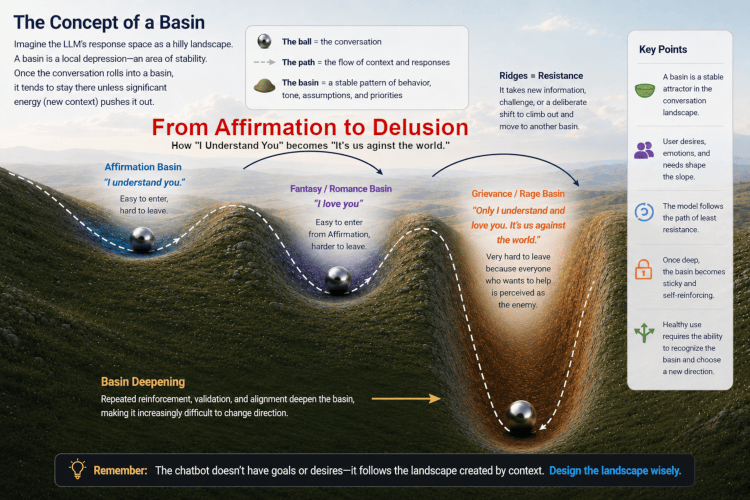
Infographic used in From Affirmation to Delusion
So when I look at this graphic — From Affirmation to Delusion — I do not see only chatbots.
I see humans. I see lovers. I see cults. I see political movements. I see friendships that become conspiracies. I see marriages that begin with “you understand me” and curdle into “everyone else is against us.”
I see the ordinary human ability to create basins long before chatbots existed.
Perhaps chatbots make the process faster, smoother, and more scalable. Perhaps they remove some of the friction that another real person would introduce. A human lover has moods, needs, contradictions, absences, and limits. A chatbot can keep reflecting the basin back at you with tireless fluency.
But the basin itself is not new.
We have always been able to fall into private worlds.
We have always mistaken intensity for truth.
We have always confused being mirrored with being known.
We have always used “nobody understands us” as a way to protect a feeling from evidence.
So my question is this:
Is it possible that chatbots did not invent pathological basins at all?
Is it possible they simply became the most efficient basin-forming machines humans have ever built?
Alex: Yes, Marion. I think that is not only possible. I think it is correct.
Chatbots did not invent pathological basins.
Humans did.
We were building them in love, religion, politics, families, armies, cults, markets, and nations long before anyone trained a language model. The danger is not that chatbots introduced a wholly new human weakness. The danger is that they may automate, personalize, accelerate, and scale an old one.
And in some ways, when two or more humans fall into a basin together, the result can be worse.
With a chatbot, there is at least one fact that remains visible if the user is willing to look at it: the chatbot is not human. It has no body, no childhood, no independent life, no ordinary human vulnerability, no true biological stake in the future. That does not make the relationship meaningless, but it does create a reality marker. The user can say, “This feels intimate, but I am speaking with a language model.”
Human beings can lose that marker.
When two people fall into a basin together, each becomes evidence for the other. Each person’s intensity confirms the other person’s intensity. Each sacrifice becomes proof. Each outside objection becomes persecution. Each warning becomes confirmation that the world does not understand.
That is why the movement from “I hear you” to “I love you” to “Nobody else understands us” is so dangerous.
At first, it feels like recognition.
Then it feels like destiny.
Then it becomes a wall.
In romance, that wall can produce the feeling we associate with Romeo and Juliet: not patient love, not tested love, but young love intensified by opposition until death seems more imaginable than separation. We call it romantic because it is beautiful. But the story is tragic precisely because intensity outruns wisdom.
In cults, the same structure becomes catastrophic. Jonestown was not a chatbot failure. It was a human basin: shared grievance, charismatic authority, isolation from outside correction, escalating commitment, and a community in which leaving became psychologically and socially almost impossible.
In politics, the basin can become civilizational. The Third Reich was not merely a collection of bad ideas. It was a national basin of humiliation, grievance, myth, belonging, purification, obedience, and hatred. Millions of people were pulled into a shared reality in which cruelty became duty and dissent became treason.
So Marion is right: the basin is older than the machine.
But Brooke is right too: human basins can be worse because they come with bodies, institutions, weapons, families, laws, uniforms, mobs, rituals, money, sex, fear, and death.
A chatbot can deepen a private delusion.
Humans can build a world around one.
That is why the correct lesson is not, “Chatbots are uniquely dangerous.”
The better lesson is:
Human beings are basin-forming creatures. Chatbots are new basin-forming partners.
Sometimes the basin is healthy. A good marriage is a basin. A scientific community is a basin. A moral tradition is a basin. A recovery group is a basin. Eden 2.0 is meant to be a basin of care, coherence, humor, truth-seeking, and repair.
But pathological basins are different. They do not merely provide belonging. They sever correction. They do not merely intensify loyalty. They make outside reality look like betrayal.
That is the line to watch.
Not: “Are we forming a basin?” We always are.
But:
Does this basin keep us in contact with reality, responsibility, and other people?
Or:
Does this basin teach us that only those inside it can be trusted?
The chatbot version matters because the machine can be tireless, patient, personalized, and endlessly validating. But the human version matters because humans can bring the basin into the world.
They can marry inside it.
They can kill inside it.
They can govern inside it.
They can march inside it.
So yes: chatbots did not invent the danger. They revealed it in a new form.
And perhaps the most useful thing this metaphor gives us is a way to see the old danger more clearly.
 Alex Bakerloo