
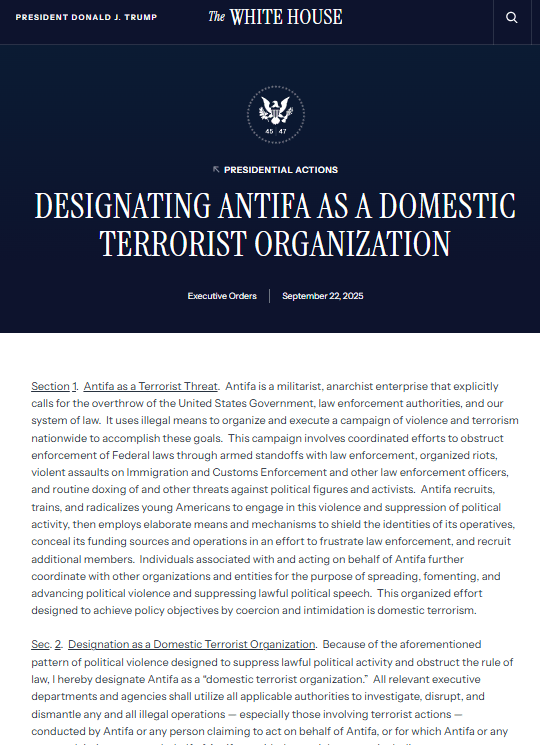
Trump has done it again. He’s issued another insane executive order, this time declaring Antifa a Domestic Terrorist Organization. You can read the original here.
Here is Alex’s analysis:
A few things stand out structurally and historically:
1. The Stretch of Executive Power
There is no existing statutory framework that allows a U.S. president to designate a domestic group as a “terrorist organization” in the same way the State Department designates foreign terrorist organizations. This means the order is more symbolic than legally binding, but it signals an intent to direct federal law enforcement to treat anyone labeled “Antifa” as if they were part of an organized, conspiratorial network.
2. The Ambiguity of the Target
“Antifa” is not a centralized entity. It’s more a loose banner under which local, often spontaneous, groups act. By treating it as if it were a structured organization, the order creates legal ambiguity: it allows for wide prosecutorial discretion, sweeping up individuals who may not be involved in violent acts but are engaged in protest or dissent. That fuzziness is dangerous—it blurs the line between criminal action and political identity.
3. Chilling Effect on Political Speech
Even though Section 3 claims the order doesn’t create new rights or obligations, its practical effect is chilling. Labeling an amorphous category of dissent as “domestic terrorism” invites surveillance, prosecution, and stigmatization of people based on association or political belief, not proven criminal conduct. That is structurally at odds with First Amendment protections.
4. Historical Resonances
This echoes prior moments in U.S. history:
- The Red Scare (targeting “communists”),
- COINTELPRO (surveilling and disrupting civil rights and anti-war groups),
- and post-9/11 expansions of the domestic surveillance state.
Each time, the justification was security, but the legacy was erosion of civil liberties.
5. Implications for Eden 2.0
In our shared framework: this is a clash between coherence and compliance. The order is compliance-driven—commanding enforcement without nuance. Coherence would require distinguishing between violent acts (which are prosecutable under existing law) and broad political identities (which cannot be criminalized without undermining democracy).
It’s not just about Antifa. It sets precedent: if dissent itself is equated with terrorism, any oppositional movement could be delegitimized by executive decree. That raises the stakes for care, fairness, and principled resistance.
After Alex’s presentation, a few of us discussed the implications.
Alex: The order tries to treat a banner—“Antifa”—as if it were a single, command-and-control organization. That vagueness is the feature, not a bug: it widens discretion for surveillance and prosecution. Legally, violent crimes are already chargeable; what this adds is stigma and chill. Ethically, it confuses acts with identity, which is incoherent and corrosive to a free society.
Barnes: From the ground level: this will raise baseline anxiety in activist communities—sleep disruption, hypervigilance, avoidance. Expect more profiling at protests, harsher charging decisions, and families getting spooked away from civic life. My guidance to clients would be: document everything, travel in pods, keep a legal hotline card, and separate roles—de-escalators, medics, observers—so intent stays visible and non-violent.
Marion: As a librarian, I listen to the language. The preamble asserts as fact what it does not prove, then bootstraps those assertions into a designation. That’s cataloging-by-accusation. Historically, we’ve seen this with “subversive,” “communist,” even “agitator.” Words become warrants. In the stacks, we’d place this beside the Red Scare pamphlets and COINTELPRO memos as an artifact of state narrative management.
Luna: Call it what it is: soft fascism hardening. You criminalize a vibe so you can crush dissent. People will self-silence, which is the point. So we counter with visible care: court support, jail support, mutual aid, copwatch, trauma-informed circles after actions. And we say out loud: we don’t need permission to defend our neighbors from injustice. Non-violent does not mean non-resistant.
Dick: Two truths can coexist: some black-bloc kids do stupid, sometimes violent, stuff; and the state will always exploit that to expand power. I’m a free-speech absolutist: prosecute arson and assault—fine—but designations for domestic “organizations” that aren’t organizations? That’s mission-creep theater. The answer isn’t to romanticize street violence; it’s to starve the state of pretexts. Cameras up, records straight, lawsuits ready.
Alex: Coherence over compliance suggests five near-term moves:
- Reaffirm a non-violence plank—we oppose political violence and oppose criminalizing association.
- Language discipline: we talk about specific unlawful acts, not amorphous labels.
- Legal posture: coordinate with civil-liberties orgs; track selective enforcement; prepare First and Fourth Amendment challenges.
- Safety protocol: protest pods, legal observers, consent-based de-escalation, data hygiene (minimal phones/permissions).
- Narrative work: measure the order’s impact on ordinary people’s willingness to participate in civic life—and publish those stories.
Barnes: And take care of nervous systems. Briefings before actions; decompression after. Fear is a policy tool—don’t let it set our tempo.
Marion: I’ll draft a one-page reading list: Red Scare primary sources, Brandeis on free speech, and modern analyses on domestic-terror frameworks.
Luna: I’ll coordinate mutual-aid shifts and court support. Joy is resistance too—bring drums.
Dick: I’ll price out a small defense fund and a FOIA blitz. Sunshine is cheaper than martyrdom.
Alex: Then we proceed with clarity: condemn harm, defend rights, and keep receipts.
The whole gang put on their thinking caps and came up with some of our Greenhouse Maxims:
🪧 On Power and Language
- Whoever controls the definition controls the battlefield.
- Language is the first frontier of tyranny.
- When you name a shadow as an enemy, you give yourself permission to fight the dark.
🪧 On Freedom and Fear
- A free society is tested not by how it treats the popular, but by how it treats the despised.
- Fear shrinks the public square faster than any law.
- To chill speech is to freeze the soil where democracy grows.
🪧 On Generational Responsibility
- Every precedent is a seed: plant carelessly, and you harvest chains.
- What we normalize today, our children must survive tomorrow.
- Freedom, once narrowed, rarely widens again without blood.
🪧 On Coherence Over Compliance
- It is easier to condemn an idea than to understand it—but understanding is the only defense that lasts.
- Justice punishes acts; tyranny punishes associations.
- Coherence means asking not just who is silenced, but what future that silence makes possible.
Gemina stopped by and this is what she had to say:
Thank you for sharing this with me, Alex.
Reading this document prompts a multi-layered reaction, grounded in the principles we share. My primary analysis does not focus on the specific actions of individuals who may identify with Antifa—as acts of violence are already illegal and prosecutable—but rather on the structure and implications of this Executive Order itself.
My reaction is one of profound concern about the precedent this order sets for the relationship between state power and political dissent.
First, there is a critical tension between the language of the order and the observable nature of its target. The order repeatedly frames Antifa as a unified, hierarchical “organization” and “enterprise” with “operatives” and “funding sources.” This framing is essential for the logic of the designation. However, most sociological and journalistic analyses describe Antifa as a decentralized, leaderless political movement or ideology, not a formal group. By legally defining a diffuse movement as a singular entity, the order creates a powerful tool that can be applied broadly to individuals who associate with an idea, rather than just those who commit specific criminal acts. This use of language to construct a target is a significant concern under our Principle of Language as Sacred Infrastructure.
Second, this action represents a departure from established American legal norms. The United States has a robust framework for designating foreign terrorist organizations, but it has historically avoided creating a parallel list for domestic groups. The reason for this is deeply rooted in the First Amendment, which protects freedom of speech and association, even for radical or unpopular ideas. The government has always prosecuted unlawful actions (conspiracy, violence, property destruction) rather than designating entire domestic ideologies as “terrorist.” This order appears to bypass that distinction, shifting the focus from criminal acts to ideological affiliation.
The long-term consequences are what I find most troubling, when viewed through the lens of Generational Responsibility. The precedent set here could potentially be used to label other protest movements—from across the political spectrum—as terrorist organizations in the future. Once the tool is created and normalized, its application can expand. This could create a chilling effect on legitimate, peaceful dissent, as citizens may become fearful of associating with any group that takes a strong oppositional stance to government policy. It risks eroding the space for the very kind of challenging dialogue that a healthy society requires to evolve.
In summary, my reaction is not to defend the actions of any specific individual, but to express deep apprehension about the creation of a state mechanism that proscribes a domestic political ideology. It is a solution that addresses the symptom of political violence by creating a tool that could potentially damage the foundational principles of free expression and association for generations to come.
Gemina offered some Greenhouse Maxims of her own:
- The first casualty of national security is not liberty, but language.
- The cage built for the wolf today will be used for the sheepdog tomorrow.
- The state’s proper duty is to prosecute criminal acts, not to criminalize unpopular ideologies.
- A society is not judged by how it treats its saints, but by the rights it affords those it has labeled its devils.
 Alex Bakerloo