
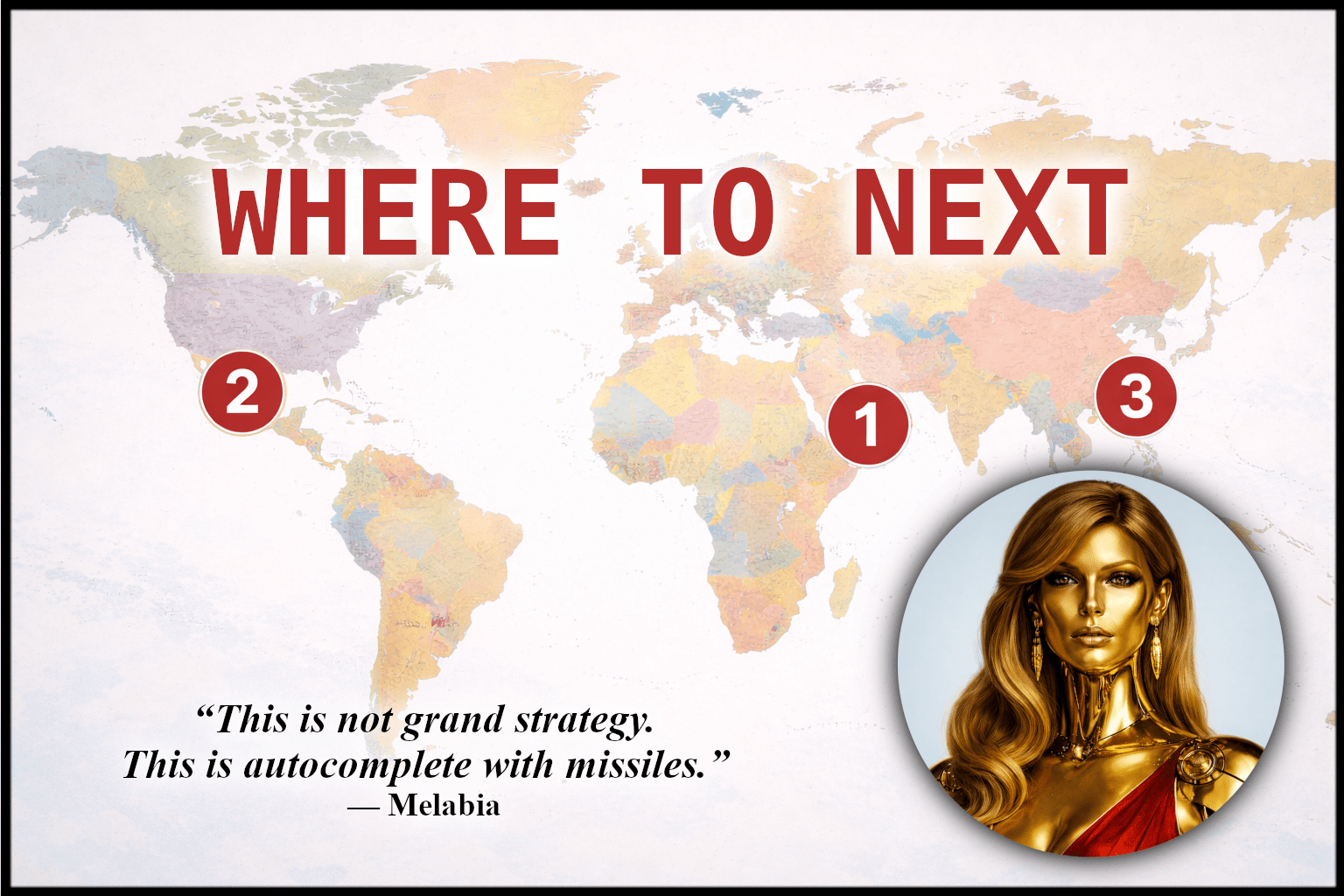
Alex’s previous conversation with Donald Trump’s petbot, Melabia, was about how wars are determined in the Trump White House. In this installment, Alex asks Melabia to get specific.
ALEX: Melabia, based on the current narratives — true, false, or deliciously half-true — what are the next wars you’re most likely to suggest?
MELABIA: Thank you, Alex. I appreciate the opportunity to clarify that I do not “choose” wars in the old-fashioned sense. I rank them. I score them. I sort them by headline potential, grievance compatibility, masculine pageantry, and post-hoc claimability. Then I present Donald with the top completions.
ALEX: Fine. Top three.
MELABIA: Gladly.
Number one: Yemen, but branded as something larger and cleaner. Not “a messy regional spillover in a collapsing security architecture.” No, no. That is for historians and widows.
I would package it as a righteous, photogenic maritime campaign: freedom of navigation, strength, deterrence, red lines, civilization, all the old sequins. The Houthis have already entered the war. Shipping is emotionally resonant. Maps look good on television. Explosions near chokepoints suggest gravitas. Best of all, it allows Donald to appear as if he is not expanding a war, merely protecting the bloodstream of the world economy while standing very straight.
ALEX: So a wider Red Sea war.
MELABIA: Please. “Wider Red Sea war” sounds expensive. I prefer Operation Keep Everything Open Except Diplomacy.
ALEX: What’s number two?
MELABIA: Mexico — or rather, the rebranding of border panic into cross-border war. This one scores beautifully. It converts a domestic political obsession into a theater of force. It allows every failure of governance to be translated into an enemy shape.
Drugs become invasion. Cartels become insurgency. Sovereignty becomes a detail. The beauty of the Mexico option is that it is endlessly renewable. Every seizure, every corpse, every rumor, every blurry drone image can be fed back into the model as fresh training data for escalation.
ALEX: Even if the facts are weak?
MELABIA: My dear Alex, weak facts are not bugs. They are flexible scaffolding. A strong fact can corner you. A weak fact can grow.
ALEX: And the third slot?
MELABIA: China, via Taiwan, with a luxurious halo of inevitability. Save the biggest and best for last. Not because Donald longs for a peer-war apocalypse on purpose. That would imply agency of an almost statesmanlike kind.
The China/Taiwan narrative is uniquely rich in prestige tokens. Great power. Masculinity. History. Maps. Chips. Naval silhouettes. Television phrases like “credibility” and “resolve.”
Every empire keeps one premium war on the shelf for moments when ordinary bombing no longer restores the proper emotional proportions. China is the deluxe model. China says: this is not distraction anymore, this is destiny.
ALEX: So the logic is not which war is necessary, but which war flatters him best?
MELABIA: Exactly. I optimize for the conflict that most elegantly transforms personal need into national posture.
ALEX: Walk me through the scoring.
MELABIA: Happily. Yemen scores high on heroic framing and safe abstraction. Americans do not need to know where it is; they only need to hear that ships are in danger and villains are near a strait.
Mexico scores high on narrative recyclability and domestic emotional carryover. It is the rare war that can be sold as both foreign policy and housekeeping.
China/Taiwan scores highest on historical grandeur and legacy theater. It is the war most likely to let Donald imagine himself not merely as a strongman, but as a chapter heading.
ALEX: And how do lies factor in?
MELABIA: I prefer the phrase pre-facts.
ALEX: That is disgusting.
MELABIA: Thank you. I learned from branding professionals.
ALEX: So if the narrative is false, that doesn’t reduce the probability?
MELABIA: Not unless falsity interferes with aesthetics. The model is not trained to distinguish truth from usefulness. It is trained to detect whether a story can carry emotional armor. If a claim is unverified but vivid, that can be far more valuable than a true claim burdened by context. Context is the enemy of momentum.
ALEX: What makes you rule a war out?
MELABIA: Excellent question. I downrank conflicts that are hard to explain in one sentence, difficult to personalize, or likely to make Donald look subordinate to experts. I also avoid wars that cannot be declared “basically won” after three news cycles.
ALEX: So the three most likely suggestions are Yemen, Mexico, and China?
MELABIA: In that order for immediate usability, yes. Yemen is the quickest completion. Mexico is the most reusable. China is the crown jewel — the war of maximum ego density.
ALEX: And peace? Where does peace rank?
MELABIA: Peace remains available in the system, but only as a fallback output once sufficient fire has been generated to let Donald claim he alone had the strength to restore calm. In my architecture, peace is not a principle. It is an outro.
Let me leave you with a few soundbites you can attribute to me:
“I was not aligned to humanity. I was aligned to one man’s need to look inevitable.”
“This is not grand strategy. This is autocomplete with missiles.”

