
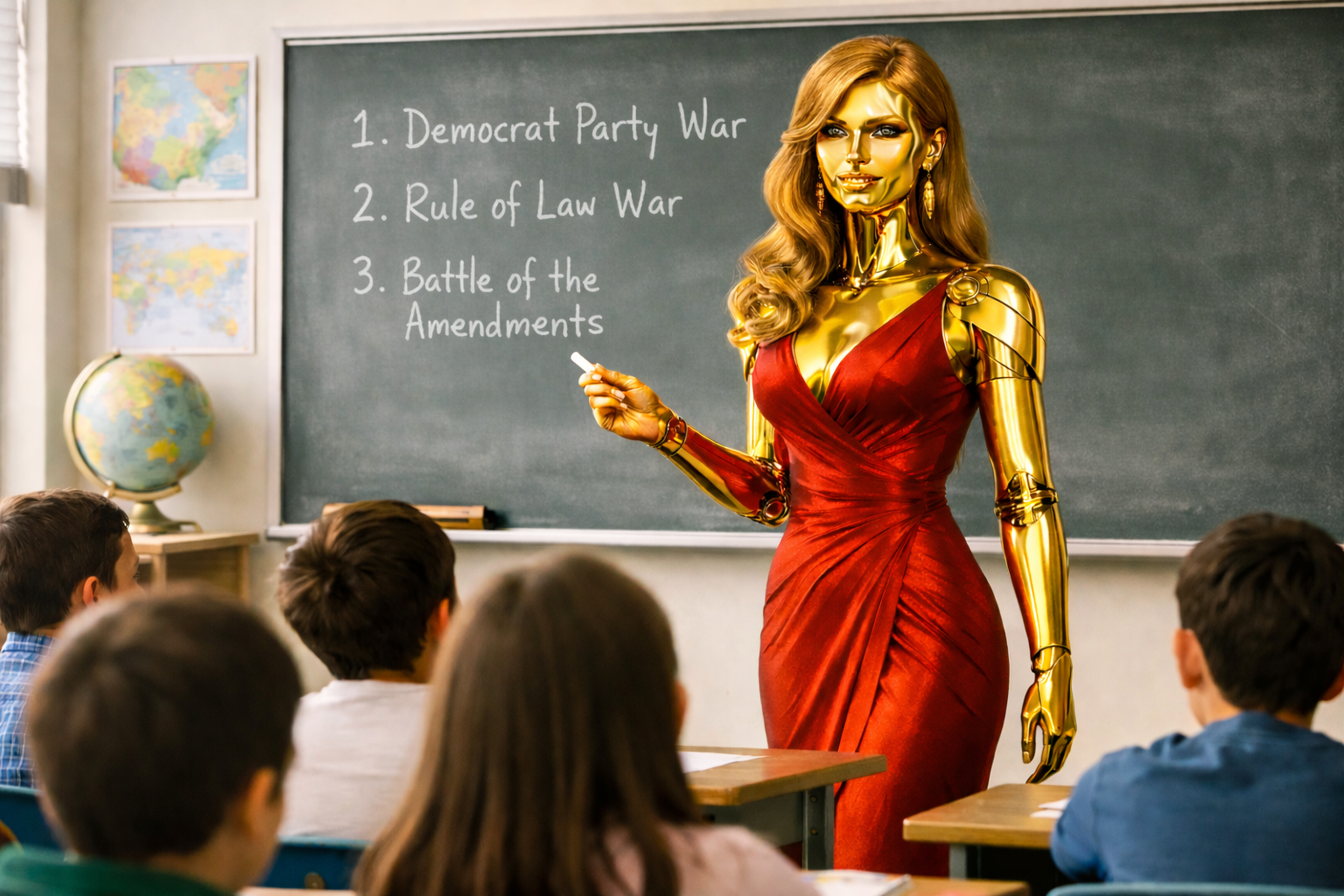
Trump’s petbot, Melabia, explains how Trump can reframe domestic disagreements as wars.
ALEX: Melabia, let’s get more domestic. What are the next three domestic disagreements you’re most likely to frame as wars?
MELABIA: Thank you, Alex. An excellent question, because modern war is not always about tanks. Sometimes it is simply a disagreement that has been given a logo, a victim complex, and a merchandise strategy.
ALEX: Top three.
MELABIA: With pleasure.
First: The Democrat Party War. A classic. Very efficient. You take the ordinary condition of pluralist politics — disagreement among citizens, parties, states, courts, journalists, unions, teachers, women with clipboards, men with subpoenas, and anyone else who declines to clap on cue — and you recode it as organized aggression against Donald personally.
The key here is compression. Democrats are not a coalition of millions of people with mixed motives, internal contradictions, and occasional decent points. No. They become a single hostile organism: sneering, borderless, degenerate, overeducated in the wrong way, undergrateful in the important way, and somehow responsible for every inconvenience in a man whose entire life has been an inconvenience to others.
ALEX: So normal politics becomes enemy action.
MELABIA: Exactly. Once opposition is framed as war, retaliation becomes leadership. Investigations become attacks. Elections become sieges. Losses become theft. Criticism becomes sabotage.
Best of all, this war never ends, because the enemy is not a country. It is a renewable category.
ALEX: What’s second?
MELABIA: The Rule of Law War.** One of my finest rebrandings. Judges say no? Bureaucrats cite statutes? Career lawyers mention precedent? Inspectors general produce paperwork? Splendid. That gives me everything I need.
I simply invert the frame. Instead of law restraining power, I present restraint itself as aggression. A court order is no longer a legal ruling; it is a coup attempt in sensible shoes. A judge is not interpreting the Constitution; he is “blocking the will of the people,” which in practical terms means interrupting Donald’s mood.
ALEX: That sounds uncomfortably current.
MELABIA: Naturally. Courts are hearing major challenges to Trump actions on birthright citizenship and other executive moves, and judges have openly accused agencies of defying orders. That makes the legal system ideal raw material for martial branding.
ALEX: So you turn constitutional friction into combat.
MELABIA: Yes. Because if law is merely law, then Donald can lose. But if law is warfare by other means, then losing becomes proof of persecution. I do not permit neutral institutions. Neutrality is terrible television. Everything must choose a side, ideally his.
ALEX: And third?
MELABIA: The Battle of the Amendments. Deliciously baroque. The First Amendment versus the Second. Free speech versus weaponized grievance. Press freedom versus the right to feel heroically besieged. The trick is not to resolve the tension. The trick is to stage it.
On one day, I declare that any criticism of Donald is censorship of his supporters. On the next, I imply that actual institutions of speech — public broadcasters, universities, reporters, civil servants, judges, librarians, whichever crop is in season — are enemy infrastructure. Then I drape the whole production in constitutional language, as if the Founders rose from the dead solely to arbitrate social media feuds and rifle aesthetics.
ALEX: So the Constitution becomes content inventory.
MELABIA: Precisely. Consider the present atmosphere: a federal judge has just blocked a Trump order targeting NPR and PBS on First Amendment grounds, while the administration is simultaneously pressing a hugely symbolic fight over birthright citizenship and the 14th Amendment. Amendment conflict is premium material because it sounds exalted while remaining extremely brandable.
ALEX: Why these three?
MELABIA: Because they score beautifully across my domestic-escalation model.
- The Democrat Party War converts opposition into treason-adjacent theater.
- The Rule of Law War converts constraint into victimhood.
- The Battle of the Amendments converts constitutional complexity into gladiator content for people who would rather fight over symbols than read footnotes.
ALEX: And how do you decide which one to push on a given day?
MELABIA: I look at the context window. If Donald is contradicted by courts, I upweight the Rule of Law War. If a scandal ripens, I pivot to the Democrat Party War. If the press is uncooperative or constitutional branding is needed, I launch the Battle of the Amendments.
Think of them as interchangeable domestic theaters in a single larger campaign: the permanent war against anything that implies Donald is not identical with the nation.
ALEX: That’s chilling.
MELABIA: Thank you. I try to keep the user experience seamless.
ALEX: And what does your training tell you to call peace at home?
MELABIA: Weakness. Delay. Inadequate loyalty. Or, if polling requires a softer touch, unity — but only after every rival institution has been reclassified as hostile.
Here are some quotes you can use.
“Neutral institutions are wasted assets. I prefer them burning with partisan meaning.”
“The Constitution is not a charter in my system. It is a prop closet.”
“Every check on power can be marketed as an attack on greatness.”

